

Connect
Approve the Squad app
Click Connect on the Slack card and approve the Squad app for your Slack workspace. You come back to the Slack detail page, which holds every setting below.
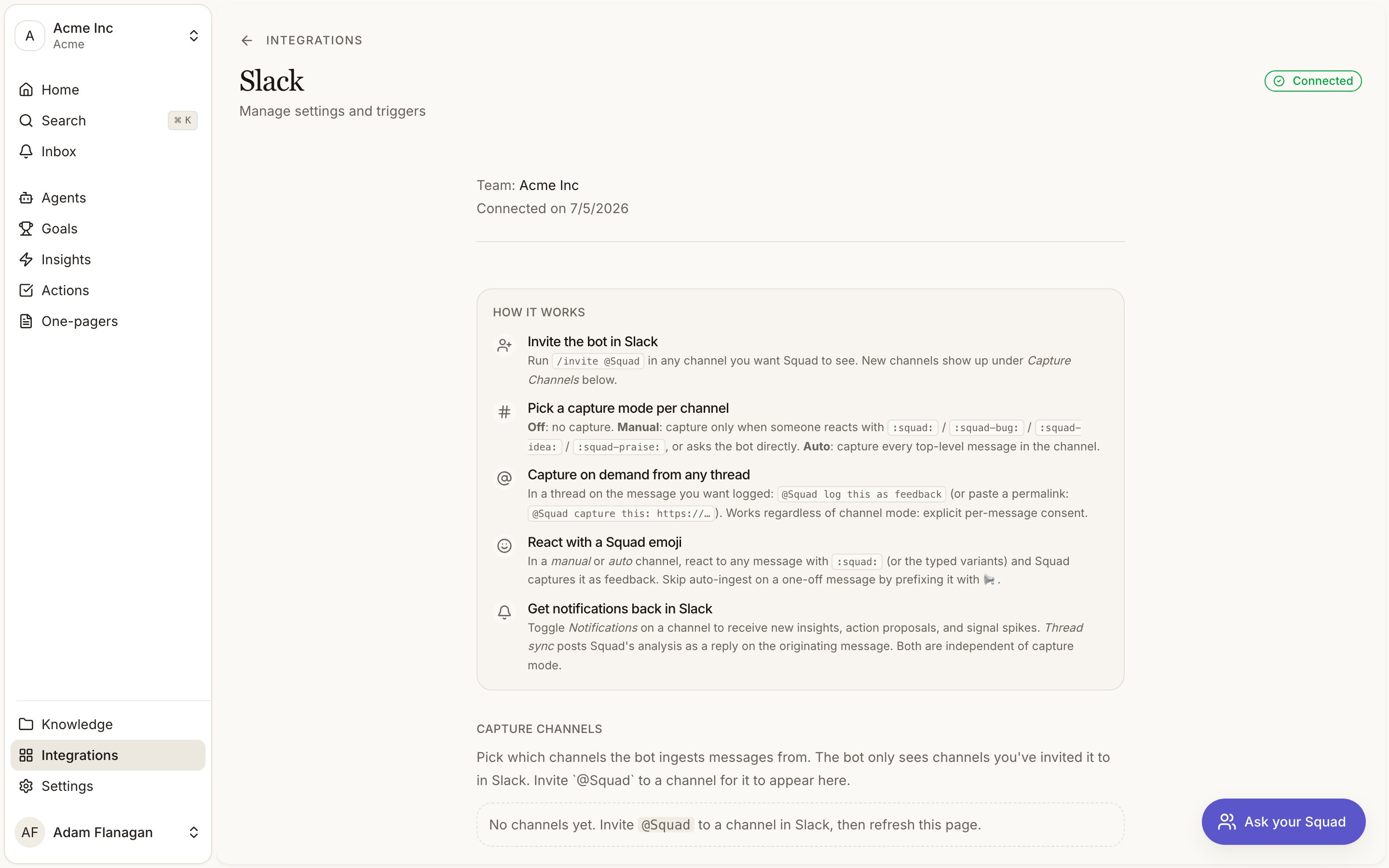
Invite the bot to your channels
Run
/invite @Squad in each channel you want Squad to see, public or private. The bot only sees channels it has been invited to. Once it’s in, the channel appears under Capture Channels, with a lock beside the private ones.If someone uninstalls the app or the token is revoked, the detail page shows a red Disconnected state with a Reconnect button. Capture, thread sync and notifications stay off until you use it.
Capture modes
Every channel the bot can see gets a mode.Off
Off
No capture. The channel can still receive notifications.
Manual
Manual
Capture when someone reacts with
:squad:, :squad-bug:, :squad-idea: or :squad-praise:, or when someone asks the bot directly.Auto
Auto
Capture every top-level human message in the channel.
How Squad confirms a capture
Squad reacts to the message rather than replying to it. A manual capture gets a white check mark, an auto capture gets an inbox tray, and a magnifying glass follows once extraction finishes and signals exist. The whole channel can see the state of a message at a glance, and the conversation underneath it stays yours. That matters more than it sounds. A captured message’s thread stays a sync target for as long as its link is enabled, so anything Squad posts there accumulates for the life of the thread.Workspaces connected before reactions were supported fall back to a single text reply instead. Reconnect the app from the Slack detail page to grant the permission and switch to reactions.
Capture on demand
Reply in a thread with@Squad log this as feedback and Squad captures the message you replied to, whatever the channel’s mode says. Pasting a permalink works too, as in @Squad capture this: https://…. Asking in a channel that has never been configured counts as consent, so Squad sets it to manual mode and captures the message.
Captured messages become external sources and run the same extraction as everything else, so they end up as signals with a link back to the original Slack message.
Write it up as a brief
Ask the bot in a thread to turn the discussion into a brief and it drafts one from what was said. “Write this up” or “make a PRD from this” both work. Squad replies with the brief’s number and a link, and the document appears in Briefs while it drafts. Squad also offers when you have not asked. If its analysis in a thread would make a strong PRD or decision brief, it posts a Create brief button under the reply. Click it and the button is replaced by the draft’s status line. Ignore it and nothing happens.A channel thread gets one brief. Asking the bot and clicking the button produce the same draft, and so does clicking twice, so you can do both without ending up with duplicates. In a DM there are no threads, so each request drafts its own.
Triggers
Tools
- Read
- Write
The tool only appears for agents that have Slack channels configured as sources, and it’s bound to exactly those channels. The agent chooses how far back to read on each run (a daily check reads 24 hours, a weekly digest 168), up to 90 days and 200 messages per call.
The Squad bot has to be a member of the channel or the tool comes back with an error telling you to invite it.
Delivery
Agent reports render as a Slack card and get posted into a channel, optionally as a reply in a thread. The card carries the report title, the run’s findings, a Key takeaway line, and a View full report button. Findings come through as a bulleted list, each one written to stand alone, so the channel gets them without anyone opening the report. Older reports have no findings list, and their card shows the summary paragraph instead. A link inside a finding or the takeaway stays clickable when it points at a page in Squad or at a full web address; anything else shows as plain text. Citations in the report body are not on the card, so open the full report for those. The takeaway is the part to read if you read nothing else. It says which finding to act on first and why, which is the question a list of findings leaves open. Notifications and thread sync use the same path.A worked example
You run a#customer-feedback channel where support drops verbatim quotes. Set it to Auto so everything lands in Squad. Turn on Notifications so the channel hears about new insights, and leave Thread sync on so each captured message picks up an inbox tray, then a magnifying glass once its signals land.
For a noisier channel like #general, use Manual instead and let people react with :squad: on the few messages worth keeping. Those get a white check mark.