

Getting there
The dashboard
The Recent activity card. Hover it and See all appears in its top right.
The Inbox popover
All activity sits at the bottom of the notification Inbox in the sidebar.
An entity detail page
All activity next to the History section on any goal, insight, or brief. These arrive pre-filtered to that entity type.
The URL
/{your-org}/{your-workspace}/activityReading a row
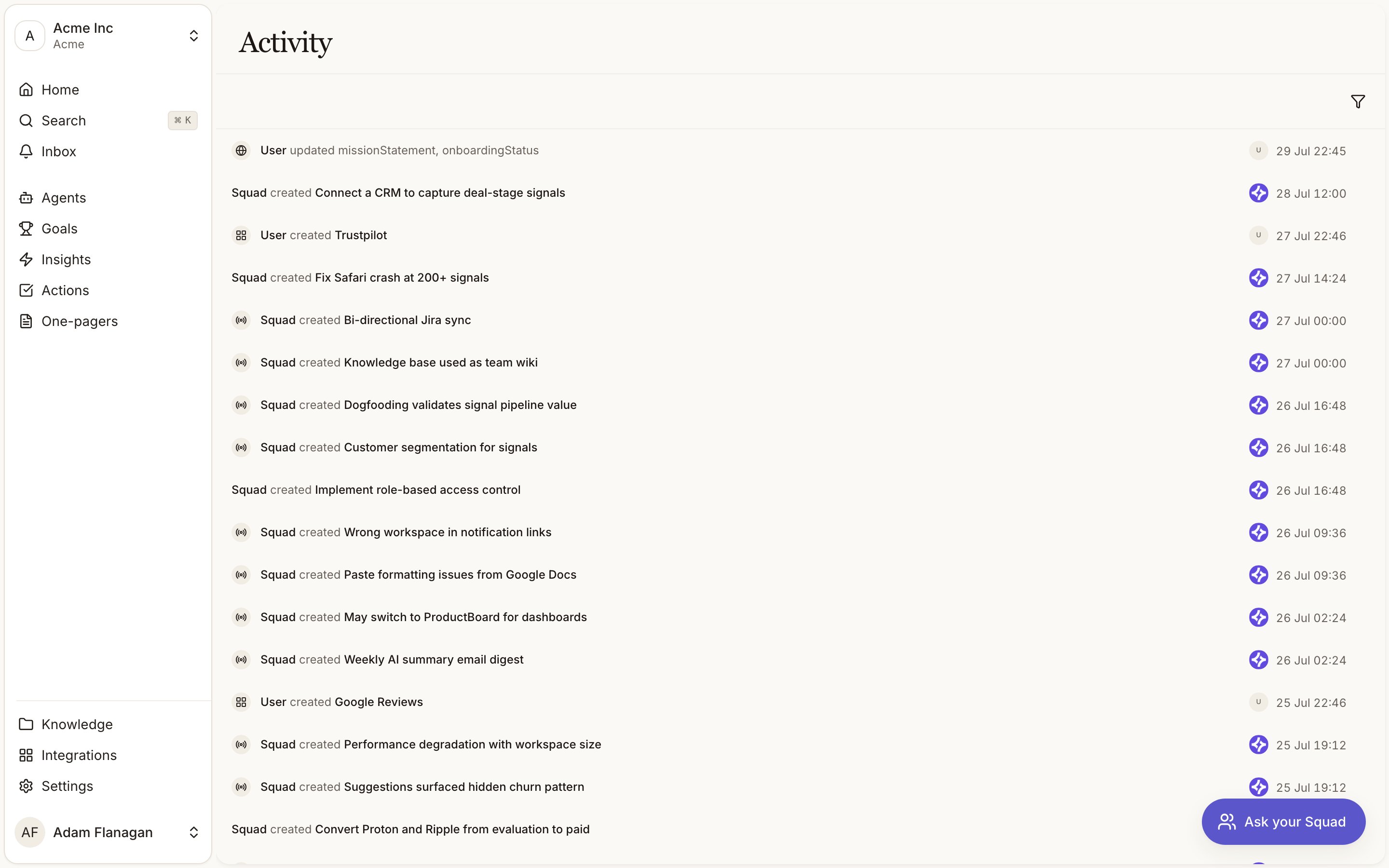
Each row is one event, written as a sentence. The actor comes first in bold, then what they did, then the thing they did it to. Squad’s own work is attributed to Squad. When a named agent made the change, the row ends withvia {agent name}. Your teammates appear by name, or by email if their profile has no name set.
The right of each row carries the actor’s avatar (a photo or initials for a person, the Squad mark for an agent) and the timestamp in DD Mon HH:MM local time, for example 07 Feb 14:03.
Hover a row for the ⋯ menu. Open jumps to the entity, when the event resolves to one. Copy event JSON puts the raw event on your clipboard.
Click a row and it expands in place. The Changes list names each field that moved, old value struck through and new value beside it. Signal events also show the signal text, and there’s a link like View goal →.
Some events read as plain statements rather than sentences, mostly around agent runs and the pipeline. Scheduled run started, Generated report, Manual run, Data signals received but none have a similar peer yet, waiting for more evidence. When nothing happened, the event says why.
Filtering
Filters live behind the funnel icon in the toolbar. Pick one and it appears as a removable chip below the toolbar. The icon turns purple while any filter is on.
Selecting more than one actor widens the feed rather than narrowing it. Agent runs are recorded against the workspace, so Workspace under Entity is where you find them.
Filtering by URL
Two filters can be set in the address bar. That’s how the pre-filtered links from goal, insight and brief pages work.?entityType=goal shows goal events only. The values are the singular entity names goal, insight, document, signal, integration, workspace.
?actorType=type:agent shows Squad’s work only. The prefix matters. For a person, use ?actorType=user:<their user id>. Take one param per request. A second copy of the same param is ignored.
Filters you set with the funnel icon stay in the page rather than the URL, so build a filtered link by hand if you want to share one.
Runs you start yourself are recorded as your action, not Squad’s, even though an agent did the work. Filtering by Squad hides them. Workspace under Entity catches every run regardless of who started it.
Loading and freshness
The feed loads thirty events at a time and pulls more as you scroll. When you reach the end it says No more activity. It refreshes itself roughly every ten seconds, so a page left open stays current. An empty workspace shows No activity yet with Activity will appear as your workspace evolves. With a filter on and nothing matching, it shows No activity matches your filters.Cookbook
Work out what changed a goal overnight
Work out what changed a goal overnight
Open the goal, click All activity next to History, and read the feed top down. Expand any row to see the exact fields that moved and their previous values.
Audit what Squad has been doing
Audit what Squad has been doing
Open Activity, filter Entity to Workspace, and scan the agent run entries. Runs that found nothing say so explicitly, which is usually the answer to “why did I get no report”.
Find who reassigned something
Find who reassigned something
Filter Action to Assigned, then Actor to the person you suspect. The row names both the old and new owner when you expand it.
Check an integration is alive
Check an integration is alive
Filter Entity to Integrations and look for Synced events. No recent sync means the connection needs attention on Integrations.